Audit your network
in minutes, not days
Automatic detection of configuration vulnerabilities across all your devices. A comprehensive catalog of customizable rules to identify risks before they become incidents.
Dozens of rules
Ready-to-use automatic detection
Customizable
Enable, disable, adjust each rule
Multi-vendor
Cisco, Huawei, Fortinet, Aruba, Linux
Actionable reports
Detailed PDFs with priorities and corrective actions
Why manual audits are no longer enough
Each network device configuration can contain security errors, inconsistencies or non-compliance issues. With dozens or even hundreds of devices, manual auditing has become an impossible task to maintain over time.
-
Unmanageable device volume
Manually auditing 50, 100 or 500 configurations device by device is unrealistic. Most teams simply don't have the time.
-
Dormant vulnerabilities for months
A Telnet protocol enabled by mistake, a forgotten clear-text password, a misconfigured trunk: these errors persist for months without detection.
-
Legacy and turnover
Taking over a network configured by a former provider or a colleague who left? It's impossible to know what's misconfigured without auditing everything.
-
Compliance hard to prove
Auditors require documented evidence. Without an automated tool, producing a complete compliance report is a time-consuming and repetitive exercise.
Sound familiar?
Intelligent Networks solves these.
Automatic configuration analysis
Intelligent Networks automatically scans configurations of all your devices and compares them to network security and operational best practices. Each anomaly is identified, classified by severity and accompanied by a clear explanation of the risk involved.
The analysis covers the entire scope: access protocols, authentication, interface configuration, VLAN consistency, Spanning Tree protections and more.
- Insecure protocols (Telnet, SNMPv1, HTTP)
- Weak or clear-text passwords
- Unnecessary services enabled
- Trunk/access inconsistencies between devices
- Different native VLAN on interconnected links
- Misconfigured interfaces
Detected anomaly examples
Unencrypted access detected on 3 devices
Unprotected credentials in configuration
VLAN hopping risk between SW-01 and SW-02
Naming convention not followed
Rule categories
Security
23 rules
Best practices
11 rules
Network conformity
14 rules
Topology
5 rules
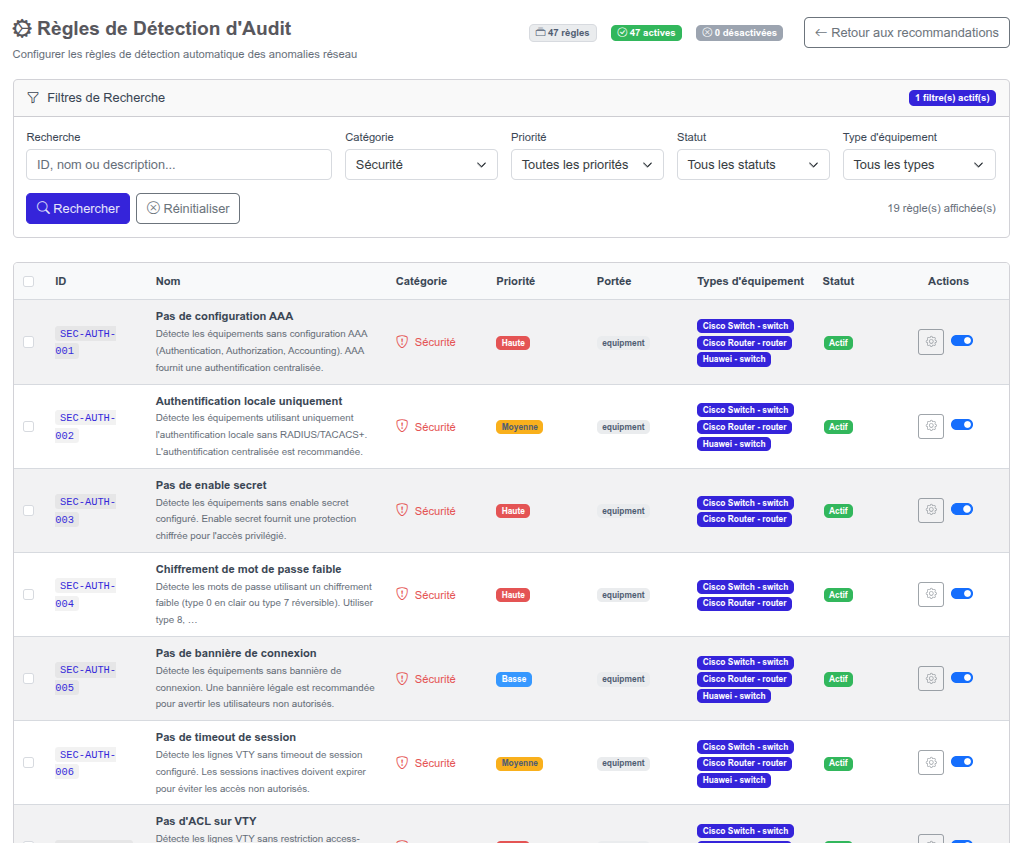
A comprehensive catalog of fully customizable rules
Each detection rule can be enabled, disabled or adjusted to your needs. Your naming conventions, tolerance thresholds, security priorities: the detection engine adapts to your network policy, not the other way around.
The engine adapts to your network policy, not the other way around.
-
Individual rule activation
Enable only the rules relevant to your environment. Disable those that do not apply to your context.
-
Adjustable parameters
Modify thresholds, expected naming conventions, authorized protocols. Each rule exposes its configuration parameters.
-
Updates included
New rules are added regularly to cover new threats and evolving network best practices.
Network security risk identification
Beyond individual configuration anomalies, Intelligent Networks detects structural risks that endanger your network security. These risks are often invisible without cross-analysis of topology and configurations from multiple devices.
-
Unauthorized routers
Detection of switches acting as unauthorized routers, creating unplanned routing paths in your architecture.
-
Trunk ports exposing sensitive VLANs
Identification of trunks without VLAN restriction, potentially exposing critical network segments.
-
VLAN hopping risks
Different native VLAN on both ends of a trunk link: a classic and often overlooked attack vector.
-
Missing Spanning Tree protections
Absence of BPDU Guard or Root Guard on access ports: risk of STP loops and network instability.
-
Missing ACLs and filtering
Devices accessible from unintended VLANs, management interfaces without access restrictions.
Detected risks
Access switch acting as an unauthorized router
Sensitive VLANs (Management, Servers) exposed
Access ports without STP loop protection
Network segmentation not compliant with policy
Automatic prioritization
AI ranks anomalies by real impact on your infrastructure
Topological correlation
Cross-referencing anomalies with topology to assess scope
Exportable reports
Evidence-based PDF reports for management and auditors
AI-augmented analysis
The AI doesn't just list anomalies: it analyzes, prioritizes and proposes concrete corrective actions. By cross-referencing audit results with network topology, it assesses the real impact of each anomaly and generates evidence-based reports.
-
Real impact prioritization
The AI evaluates the severity of each anomaly based on its position in the topology, the number of impacted users and the risk of propagation.
-
Suggested corrective commands
For each anomaly, the AI suggests corrective commands tailored to the affected device vendor.
-
Evidence-based audit reports
Export detailed PDF reports with findings, severity, estimated impact and remediation plan. Ready for auditors and management.
Living recommendations, not a frozen report
An audit only has value if it is acted upon. Every detected anomaly becomes a recommendation attached to its site and device, with its solution, priority and processing status.
-
Every anomaly comes with its solution
Problem description and remediation steps, generated by the detection engine.
-
Processing tracking
Discovered, in progress, resolved: the team sees what remains to be done, per site and per device.
-
Auto-resolution
Problem gone at the next collection? The recommendation closes itself — the audit always reflects the real state of the network.
-
Topology is audited too
Single-uplink switch, isolated device, LLDP inconsistencies: dedicated rules for the physical resilience of the network.
Lifecycle of a recommendation
Anomaly detected during analysis — priority and solution assigned.
Taken over by a technician.
Fixed and verified by your teams.
The problem disappeared from the network: automatic closure at the next collection.
Why choose Intelligent Networks?
Network audit approach comparison
| Feature | Intelligent Networks | Manual audit | Scripts / Traditional tools |
|---|---|---|---|
| Automatic configuration analysis | Partial | ||
| Dozens of configurable rules | Limited | ||
| Native multi-vendor | |||
| Integrated AI analysis | |||
| Topology correlation | |||
| Threshold customization | N/A | ||
| Exportable PDF reports | Manual | ||
| Execution time | Minutes | Days | Hours |
Concrete use cases
How our clients use the Network Audit module daily
Compliance audit
Auditors require compliance evidence? Run an automated audit, export the PDF report and provide a complete security assessment of your infrastructure in minutes.
Infrastructure takeover
Taking over a network inherited from a former provider? In minutes, identify all configuration anomalies, security vulnerabilities and deviations from best practices.
Security hardening
Systematically identify all configuration vulnerabilities: insecure protocols, default credentials, exposed ports. The AI-prioritized report guides you in the optimal remediation order.
Migration preparation
Before migrating a site or datacenter, verify the consistency of all configurations. Identify VLAN inconsistencies, misconfigured trunks and hidden dependencies before touching a single cable.
Continuous monitoring
Detect configuration drift over time. A change introduced an anomaly? The automatic audit detects it at the next collection, before it causes an incident.
Client report
Are you a service provider? Provide your clients with a documented and professional assessment of their infrastructure. The automatically generated PDF report strengthens your credibility and added value.
Ready to automatically audit your network?
Dozens of customizable rules, AI analysis and exportable reports